
What to see in the Dordogne Valley?
The Dordogne Valley stretches across three departments: Corrèze, Lot and Dordogne.
Le Moulin du Boisset is situated at the junction of these three departments, allowing you to explore a wealth of sites of unexpected richness.
To present them to you more clearly, we have chosen to group them into two sections:
- Places to visit in the Lot department, including all the treasures of the Dordogne Valley and, further afield, those of the Lot Valley.
- Places to visit in the neighbouring departments of Dordogne and Corrèze.
Things to see in the Lot
On the borders of Aquitaine, Limousin and Auvergne lies the department of Lot, also known as Quercy.
Three rivers shape its landscape:
- To the north, the Dordogne valley crosses the department for some fifty kilometres.
- To the south of the department lies the Lot valley. Its course is capricious, carved by winding meanders through the vast limestone plateau.
- Running parallel to the Lot, the Célé Valley, a tributary of the Lot, is also a miniature replica of it.
The limestone plateaus, or ‘causses’, with their moorland and forests of small oaks, dotted with dry-stone buildings, form part of the Causses du Quercy Regional Nature Park.
It is a department rich in heritage and tourist attractions, just waiting to be discovered, particularly through its beautiful stone architecture, hiking trails, rivers, gastronomy and, of course, its people.
7 villages have been awarded the "Most Beautiful Villages" label: Autoire, Capdenac-le-Haut, Carennac, Martel, Saint-Cirq-Lapopie, Cardaillac and Loubressac.
Things to see near the Lot
If you have a thirst for knowledge, are passionate about historic buildings, and enjoy strolling through the narrow streets of towns and villages steeped in history, you’re in for a treat.
The Lot, already rich in attractions, is bordered in its northern part by a multitude of tourist destinations.
First and foremost, the Dordogne department, and in particular the Périgord Noir. Its finest example is the town of Sarlat, the cultural capital of the Périgord. Then there is the ‘Golden Triangle’ of the Dordogne valley, comprising seven villages: Domme, Cénac, Castelnaud-la-Chapelle, Vitrac, La-Roque-Gageac, Vézac and Beynac-et-Cazenac, four of which are listed among ‘The Most Beautiful Villages of France’.
To the north of the Lot lies Corrèze, with the villages of Turenne, Collonges-la-Rouge and Curemonte.
Collonges, an architectural gem set within the emerald of a lush countryside.
Finally, Brive-la-Gaillarde, where the grandeur of historic monuments blends with the charm of the narrow streets that curve around the Collegiate Church. Brive is the starting point for a visit to the town of Aubazine and its famous abbey, and Les Pans de Travassac, one of the last open-cast slate quarries in France.
The interactive map below will help you see all the sites near the Mill that you can visit.
The first circle represents a 30 km radius, whilst the second covers a 50 km radius.
You can click on each icon for further information.

During your stay, we’ll be happy to help you discover the various places of interest and suggest the best routes to take.
About Saint-Denis-lès-Martel
Le Moulin is situated in the commune of Saint-Denis-lès-Martel.
Saint-Denis-lès-Martel lies at the confluence of the Dordogne and Tourmente valleys, which has made it an important crossroads for the movement of people and goods since time immemorial.
This is the case with the Puy d’Issolud, a limestone plateau that has been inhabited since the Palaeolithic era and which, due to its rugged terrain, became a fortified settlement (oppidum). It was here that, in 51 BC, the last great battle between the Gauls and Julius Caesar officially took place, during which Caesar employed a clever stratagem to dislodge and subjugate the indomitable Gauls. This was the Battle of Uxellodunum, a major site in our national history. The site is currently open to visitors and you can find all the information on the website www.uxellodunum.com.
In the Middle Ages, the conflicts of the Hundred Years’ War and the constant insecurity led to the creation of Saint-Denis-lès-Martel from the merger of three parishes: Saint Dyonis, Sainte-Radegonde, and Saint Martin-de-Farges.
Along the cliff face running alongside the railway line, numerous traces of dwellings and shelters remain.
Further evidence of significant human settlement in this valley, where water flows in abundance, can be seen in the many mills, still visible today (Balme, Briance, Boisset…), alongside a multitude of bread ovens skilfully restored by their owners.
From 1860 onwards, with the dawn of the industrial era, the arrival of the railway in the countryside spurred the growth of Saint-Denis-lès-Martel. The station established there enabled the development of the town, with hotels, shops and public services, helping to make our village a well-known and recognised regional railway hub. This was the golden age of Saint-Denis, when its population reached 900. You can still admire some of the façades of these buildings in the village centre. On the station platform, you can also discover one of the last manual signal boxes in France.
Today, the Martel tourist steam train also remains from this era, bearing witness to this rich past. Its route, which takes you through tunnels, over viaducts and along stone-paved paths along the cliffs, allows you to discover the magnificent views of the village as well as the Dordogne, which winds its way not far from the village.
You can explore the many hiking trails that will lead you to its banks.
Not to be missed
- Uxellodunum
- Briance Mill and its waterfall
- The bread ovens at Scourtils
- The wash houses
- The station and its manual points
- The Miret Bridge and the Eiffel Bridge over the Dordogne
- The banks of the Dordogne
- The model railway
- The panoramic views
- The Scourtils viaduct
- The hiking trails
- The cliffs of Mirandol
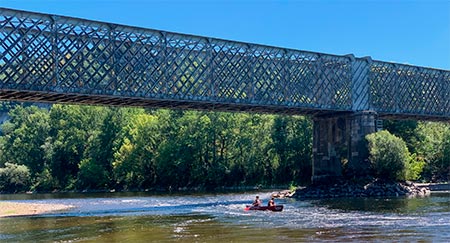
Eiffel Bridge over the Dordogne
Get the magazine free of charge
Dordogne Valley
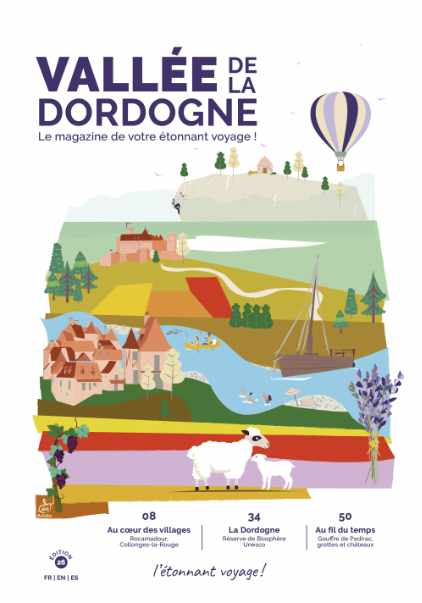
This is the definitive guide, published by the Dordogne Valley Tourist Office, which brings together the main places to visit, activities, a calendar of festivals and events, market times and days, and recommended places to visit...
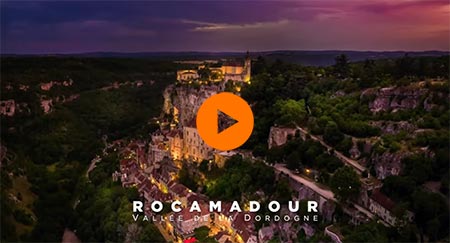
The Dordogne Valley in videos
There are countless places to visit in the Lot and the Dordogne Valley, with something to suit every taste: spectacular landscapes, cultural, historical and geological heritage, events, fairs and markets…
To help you discover all this, you’ll find below a small selection of videos about our region.
Not to mention the warm welcome from the locals, who will greet you with open arms.





To contact us quickly,
click on the instant messaging button.
We’ll get back to you very shortly.

To switch from dark mode to light mode
or vice versa, click here.
To check availability or
book your stay quickly,
securely and at the best price,
click this button.


To manage your cookies,
click on the button shown
here only on the home page.

PLEASE NOTE
• For the rooms, we use the STRIPE™ secure payment system. A 25% deposit will be required to confirm your booking.
• For the gite, pre-booking is done online without immediate payment. A rental agreement will be sent to you by email upon receipt of your pre-booking.
This agreement will include our IBAN, to which you must transfer 25% to confirm your booking.
• For the rooms, we use the STRIPE™ secure payment system. A 25% deposit will be required to confirm your booking.
• For the gite, pre-booking is done online without immediate payment. A rental agreement will be sent to you by email upon receipt of your pre-booking.
This agreement will include our IBAN, to which you must transfer 25% to confirm your booking.

Le Moulin du Boisset 2016-2026
All rights reserved
Availability
Le Moulin du Boisset 2016-2026
All rights reserved